I have decided to make some rhythm and finger exercises based on the Faber Primer book. I got the idea of making them label from Susan Paradis.
I am assigning the student these exercises to have some extra practice with counting and playing rhythms and coordinating fingers. I have placed page numbers on some exercises because the correlate with that page.
Though some are the exact pattern found in the song, some are combinations of patterns. I am assigning these exercise one to two weeks before the student gets to that page, so they have done the preliminary work on the song already.
There are many possibilities with the rhythms, playing hands separately, hand together, clapping, stomping, patting, snapping, playing with instruments, counting out loud, playing on the keyboard, etc. .
I use Avery labels 48860 with a measurement of 1" by 2 5/8'
Faber Primer Level Rhythm and Finger Exercises
If you have trouble printing them, email me and I will email you a pdf file
Wednesday, September 8, 2010


Monday, September 6, 2010
Eight is Enough Game
I have come up with a new game called "Eight is Enough"
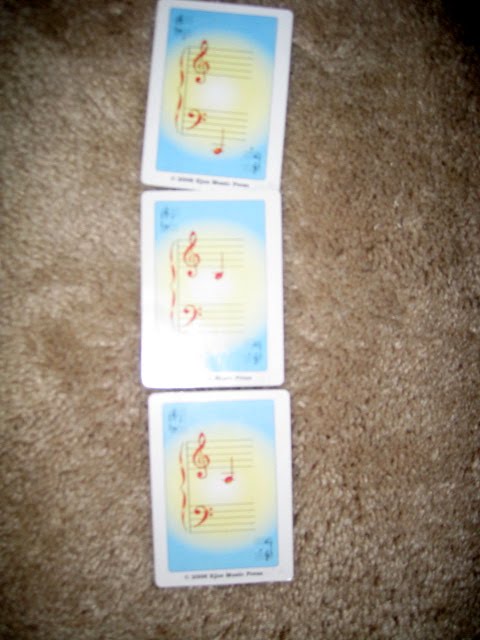
To play you need staff playing cards with a set of A- G. I recommend two sets of A-G for each player. Staff playing cards don't have the answer of what note it is on the back. I have some flash cards I made. I suggest printing or copying them on card stock and then cutting them out.
Staff Playing Cards
Flash Cards
Each player gets four cards and the rest of the cards go into a pile. Four cards are set around the pile, face up.
The youngest player goes first.
Each player takes turns building on the card that is face up. You can build up or down regardless of clef. So if the starting card is a Middle C you can put a Treble D above it or a Bass Clef B below it.
When you play a card you draw another card from the pile. If you have no card to play you forfeit your turn. You can trade in two cards in your hand for two cards in the pile, placing your two cards at the bottom. If you trade in two cards, your still forfeit your turn and may not play a card until the next turn.
The person who plays the eighth card wins the pile. The person who gets four piles is the winner of the game.
Variations: You could make the piles move up and down by intervals: 3rd, 4th, 5th, etc. . You could also do chords.


To play you need staff playing cards with a set of A- G. I recommend two sets of A-G for each player. Staff playing cards don't have the answer of what note it is on the back. I have some flash cards I made. I suggest printing or copying them on card stock and then cutting them out.
Staff Playing Cards
Flash Cards
Each player gets four cards and the rest of the cards go into a pile. Four cards are set around the pile, face up.
The youngest player goes first.
Each player takes turns building on the card that is face up. You can build up or down regardless of clef. So if the starting card is a Middle C you can put a Treble D above it or a Bass Clef B below it.
When you play a card you draw another card from the pile. If you have no card to play you forfeit your turn. You can trade in two cards in your hand for two cards in the pile, placing your two cards at the bottom. If you trade in two cards, your still forfeit your turn and may not play a card until the next turn.
The person who plays the eighth card wins the pile. The person who gets four piles is the winner of the game.
Variations: You could make the piles move up and down by intervals: 3rd, 4th, 5th, etc. . You could also do chords.

Friday, September 3, 2010
Fun Magnets
I love these Smiley Face Magnets I found for $1.00 at Target. I use them to represent notes on the staff on my magnetic white board I made. I also found some heart shaped ones for Valentine's day.


Thursday, September 2, 2010
Place Race

To start off the new fall semester I chose to play a new game called "Place Race" to review the notes, chords and keys. This is a great review game at the beginning of the year because you can limit what you test the student on. To play you need alphabet cards, staff cards and a stop watch. For Level One, I set out two rows of alphabet cards C D E F G. I make the first row Treble Clef and the bottom row Bass Clef. I give the student flash cards for C position in both clefs. I have the student place the correct staff card on the letter and time them to see how fast they can match them up. Then we play again and I see if they can beat their first time. Here are some suggested levels, but I had one student who had a piece with ABCDE ledger lines in between the clefs, so I pulled out those flash cards and had her match them up.
Level One: C position (Top row Treble Clef, Bottom row Bass Clef)
Level Two: Lines and Spaces of the Treble Clef (Top row lines, bottom row spaces)
Lines and Space of the Bass Clef (Top row lines, bottom row spaces)
Level Three: Ledger Lines (Top row Treble Clef, Bottom row Bass Clef)
Level Four: Chords (Top row major, bottom row minor)
Level Five: Keys (Top row Sharps, Bottom row Flats)
Keys (Top row major, Bottom row relative minor)
I could see modifying this to include intervals as well, rhythm values, just by changing the alphabet cards to number cards.
Sunday, May 23, 2010
Group Lesson Stations
These week I will be having group lessons and I am trying a new thing: STATIONS.
Usually I have game and activities and all the students play together at group lessons. This has gone well, but when I have different levels of students, it can be a challenge. I have been substitute teaching lately and many school teachers use stations for math or reading. The kids have assigned groups and they go to the station and complete the activity either together or by themselves. The kids really enjoy stations and I thought I would try it in a group lesson.
I have four stations and each has a game or activity for the students to complete. Each activity has different levels for the students to choose from, so that they will be reviewing concepts they have learned. The material and instructions for the activity is at the station and they are all games we have played before in our lesson time. The students are paired up other students on their same level. Every ten minutes we will rotate to a new station. This format allowed me to have students of different levels and have more students come to one group lessons.
I usually like to keep group lessons to 5 or 4 students, but this week one group lesson will have seven students! I think the rotation will keep all the students busy, while keeping the groups small at each station. I have attached an example of the instructions I have for "Chutes and Ladders" I have made rhythms on different colored note cards that students add or subtract. Since then I have added Rhythm Addition Cards to my site, which would be an easy way to play the game in different levels. A great way to review rhythm with a game the students love. Enjoy!
Chutes and Ladders Directions
Usually I have game and activities and all the students play together at group lessons. This has gone well, but when I have different levels of students, it can be a challenge. I have been substitute teaching lately and many school teachers use stations for math or reading. The kids have assigned groups and they go to the station and complete the activity either together or by themselves. The kids really enjoy stations and I thought I would try it in a group lesson.
I have four stations and each has a game or activity for the students to complete. Each activity has different levels for the students to choose from, so that they will be reviewing concepts they have learned. The material and instructions for the activity is at the station and they are all games we have played before in our lesson time. The students are paired up other students on their same level. Every ten minutes we will rotate to a new station. This format allowed me to have students of different levels and have more students come to one group lessons.
I usually like to keep group lessons to 5 or 4 students, but this week one group lesson will have seven students! I think the rotation will keep all the students busy, while keeping the groups small at each station. I have attached an example of the instructions I have for "Chutes and Ladders" I have made rhythms on different colored note cards that students add or subtract. Since then I have added Rhythm Addition Cards to my site, which would be an easy way to play the game in different levels. A great way to review rhythm with a game the students love. Enjoy!
Chutes and Ladders Directions
Subscribe to:
Posts (Atom)

-
 Intervention are essential to helping your students become proficient in fundamental skills for reading and math. As you assess your ...
 -
It is Dr. Seuss' Birthday on March 2nd and to celebrate I have compiled some songs inspired by his wonderful books Click on the pict...
-
 The Very Hungry Caterpillar by Eric Carle is a classic book for children. It has beautiful pictures and a presentation of the story that is...
